Monday, September 19, 2016

Fischer for Zion 2017

Back in Campaign Mode

Multitasking


I had the day off and I decided to walk over to City Hall in order to get a couple of miles of steps in, and to pick up a petition packet for the April 2017 Consolidated Election.

City offices are behind a security door, so you have to call the extension for the City Clerk to gain entrance. I dialed Diane Burkemper's extension, left a message, and then sat down to wait. Rich Ianson, the Director of Building and Zoning, came through the lobby, said hello, and let me know that Diane was out at the moment. So I called the extension for Sheryl Spooner, the Deputy Clerk, and told her I was there to pick up a nomination packet.  A few minutes later, she collected me from the lobby and took me back to the office.

I checked the packet to ensure all the necessary documents were included, and put my contact information on a notification list just in case any issues arise regarding the petition forms, or the filing process, so that the Clerk would be able to let me know.  Providing the information is voluntary, and sometimes it is useful to see who else has picked up a packet and get an early read on the competition. Except in this case, it seems I am the first on the list.  Sheryl was very helpful, and soon I was on my way home with my papers secured in a portfolio.

The Magic Number

If you have read some of my previous blog entries, you will know, that according to the Illinois statute, the required number of signatures to qualify as a candidate for the office of Commissioner is based on one percent of the total votes cast in the most recent Mayoral election in the municipality.
The formula: 2,197 Votes x 1% = 22
This is confirmed by the cover sheet for the packet, which lists the minimum signatures required as 22. I will probably collect between 30 to 40, just to give myself a safe margin.

The Calendar

 As of today, it is 197 days until the April 4, 2017 election.  September 20th, is the first day that petitions can be circulated, with the first day of filing on December 12th, and the last day on December 19th.  Voting by mail for this election starts March 13, 2017, followed by the start of early voting on March 20, 2017. Then, of course election day on April 4, 2017.

I will be making a formal announcement in the next couple of weeks and sending that off to the local paper. Also I am working on an updated platform to address a range of issues concerning the city and it's residents. If you are a registered voter, live in Zion, and would like to show your support by signing my petition, let me know and I will arrange to meet you. Or, if you like, you can find me at City Hall tomorrow evening attending the City Council meeting that starts at 7:00 pm.  I look forward to seeing you there.

Website updates are coming:  www.fischerforzion.com

If you have a concern of issue that you want to see addressed and discussed in this upcoming election, I want to hear it. Leave me a comment here, or email me directly at fischerforzion@gmail.com

Tuesday, July 12, 2016

Needed: A Long Term Solution

Nuclear Fuel Storage Casks staged for loading - Zion, December 2012 Author's Photo
 Today, I have been reviewing the press coverage of  Congressman Dold's bill, "The Stranded Nuclear Waste Act", HR-5632-press-release, and while I applaud the fact that this problem is finally getting some serious attention from our federal representative, I am skeptical that the bill will actually be passed during this session.  Beyond that, I don't feel that the proposal goes far enough to address the long term impact of the storage site on the City of Zion and the surrounding community.

The biggest fault is the fact that there is a seven year limit on the compensation. The reason given, is to prevent the community becoming reliant on federal dollars, and supposedly to prompt Congress to take action on the storage problem. Now, the projected $15 million a year compensation is not inconsiderable, but when measured against the projected lifespan for the nuclear storage casks of 50 years or more it's not that much. As for getting Congress to move on a problem because it might cost a few hundred million over a few years ignores history and reality. Even with a best case scenario, in which Yucca mountain opened tomorrow, I have learned that it might take up to 30 years to move all the stored fuel to another site. The fact is the fuel isn't going anywhere for quite some time.

The second problem I have is with the statement from Mayor Al Hill, that his hope is that these funds will allow the city to lower taxes, which will hopefully draw economic development, and kick-start a cycle of development that will improve the economy and ease the tax burden.  As a theory, I think that is a worthy goal.

I would like to propose a better idea, rather than hoping to lower taxes for businesses, let's actually lower the taxes for businesses!

In fact, I already proposed this idea over a year and half ago during my campaign for Commissioner. From my blog post: "Candidate Questionnaire Sneak Peek", Fischer for Zion - February 2015 

Q. Briefly explain how would you address the high taxes in Zion? 

Q. Briefly explain how would you address economic development in Zion?


A. I propose that the city apply for Enterprise Zone Status under the Illinois Enterprise Zone Act, to give us access to special tax and regulatory incentives for businesses.  I also propose that the Act be amended to include the Nuclear Fuel Storage Facility in the same criteria as an abandoned coal mine, or brownfield site, and the Enterprise Zone status should not expire until the spent fuel is removed from our Lakefront. These proposals provide practical means towards growing our local economy while helping reduce homeowner taxes, and obtaining some compensation for the detrimental impact of the nuclear storage site on our community.
 Since I made that proposal, there have been more cases where a business considering locating in Zion has instead gone to Wisconsin or elsewhere because Zion couldn't offer the kind of tax incentives to be competitive. No matter what the outcome of the proposed bill, we still need the leverage of an Enterprise Zone to compete with cross border competition.

Another issue that was mentioned in the press conference, is the increasing rate of poverty in Zion, reflected in the unbalanced proportion of rental property to homeowner occupied which is now 60% to 40%, and the highest number of Section 8 housing in Lake County.

To address the housing problem, and the long-term economic impact on the city, I would propose the creation of a special Homestead exemption for tax assessments that would be tied to the Nuclear Storage Site, similar to what I have proposed for the Enterprise Zone. Just like the existing special exemptions for Veterans and Seniors, this would be an additional exemption for residents living in Zion, Winthrop Harbor, and Beach Park, in order to compensate for the economic impact of the Storage Site. Added to that, there should be an additional incentive exemption for first-time home-buyers that would be available for the first two years in order to encourage conversion from rental properties to ownership.  After that, as long as they qualify for the standard Homestead exemption, they would receive the additional Nuclear Homestead exemption.

As I stated above, seven years of cash payments isn't bad, but before everyone gets caught up in what can be done with that money (which we don't have yet), let's not lose sight of the long term needs and how we can address them.

Sunday, May 29, 2016

Memorial Day Remembrance: The Last Casualty of the Cold War

On this holiday weekend, dedicated to honoring those who have fallen in defense of this nation I am going to step away from my usual comments on local issues, politics and campaigns to remember a particular passing that occurred 31 years ago.

  A Classified Briefing


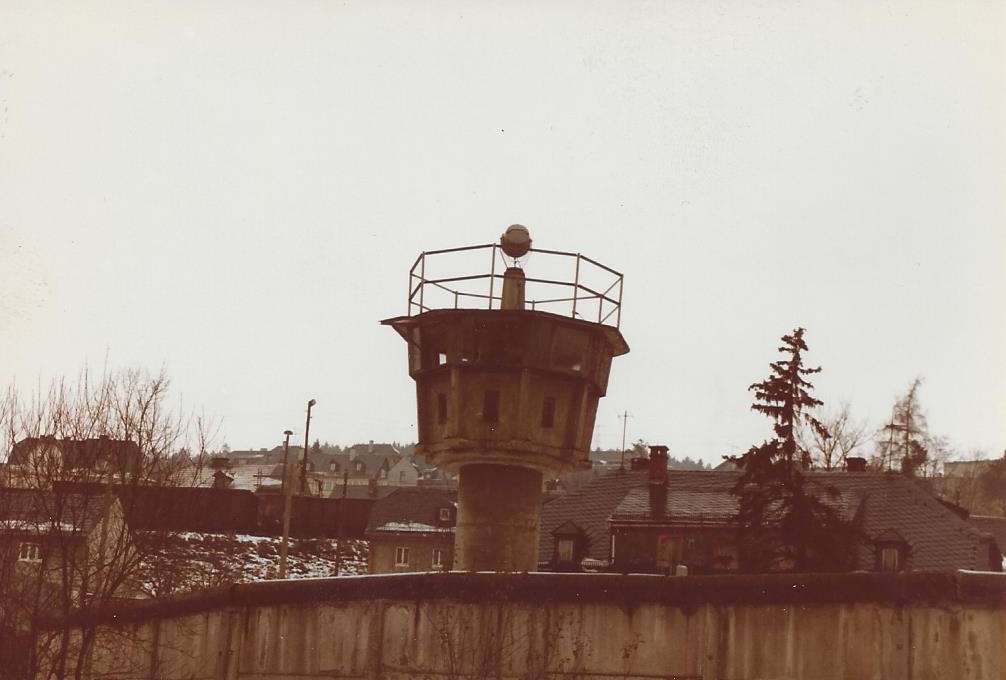
East German Guard Tower, Author's Photo

In 1985 I was an Army Specialist with the 103 Military Intelligence (MI) Battalion, at the 3rd Infantry Division Headquarters in Würzburg, West Germany. For those who weren't around, or were too young to remember the last decade of the Cold War, a quick reminder of the world that we were living in at the time.

Europe had been divided between the Soviet Union's Warsaw Pact nations, and NATO's alliance of Western powers for 40 years. The border separating East and West Germany had been fortified by the communist governments ostensibly to protect their citizens, but effectively imprisoning them. In the previous 15 years, the Soviets had been pushing a massive military buildup in their part of Europe, to the increasing worry of the U.S. and her allies.  The Reagan Administration had countered with the deployment of Pershing II nuclear missiles, nuclear cruise missiles, and a more confrontational stance in it's relationship with the USSR.  For it's part the Soviet leadership feared that Reagan was planning a preemptive nuclear strike against them, and as a result were even more defensive and bellicose about protecting their territory.

This atmosphere of tension and mistrust created a fertile ground where even the smallest mistake could result in an overreaction, with deadly consequences.   The shoot-down of Korea Airlines Flight 007 by a Soviet fighter jet just two years earlier had been such an incident. Members of my unit still had vivid memories of the midnight scramble as U.S. forces worldwide went into high alert afterwards.  As ever, the Cold War between the Superpowers remained balanced on a tipping point, no one knew what might send either side over the edge into a third World War.

That's why, when I and the rest of our unit of Intelligence Analysts and Linguists were called in for a special briefing by the Division S2 (Staff Intelligence), we knew something big had happened.

I can't recall whether this briefing took place one or two days after it happened, but the Captain informed us that on March 24th, a Major Arthur Nicholson a member of the U.S. Military Liaison Mission (USMLM) had been killed by a Soviet sentry when the Major was making observations of a tank shed near Ludwigslust East Germany.  

The members of the Military Liaison Mission have a unique place in the world of Intelligence gathering,  under a 1947 treaty, the officers were allowed to travel (unarmed) in areas of East Germany to observe military installations and equipment. There were strict rules in place for the treatment of Mission officers from both sides, who were essentially acting as acknowledged spies.  The murder of Major Nicholson came as a shock to us in the Intelligence community.

The Captain let us know that the Soviets had prevented the Major's driver Staff Sergeant Jessie Schatz from providing first aid, and that the Major had probably bled to death while the Soviets left him untouched for over two hours. A sense of outrage at this news filled the room, along with the cigarette smoke as several soldiers took a nervous drag.  (Remember, this was when "smoke em' if you got em'" was still a common phrase.)

Most of what the Captain told us in the rest of that meeting has since been declassified, but at that place and time the unspoken question was in all of our minds, could this be the critical moment we all dreaded? Would the balance hold?

The political and diplomatic ramifications between the U.S. and the Soviets after the incident were severe, especially in the face of the Russian's insistence that they were not at fault. But the balance did hold, and within just a few years the Soviet Union itself no longer existed.


We didn't know then that the long twilight conflict that defined the second half of the 20th Century, was coming to a close, and that Major Nicholson would later be officially recognized as the Last Casualty of the Cold War.

Major Nicholson was interred at Arlington National Cemetery, and posthumously promoted to the rank of Lieutenant Colonel by Presidential Order.


The official memorial page for Nicholson can be found here: Army Memorial Page

The Cold War Spies site also has a tribute page with an account of the incident, and links to the declassified report: http://www.coldwarspies.com/reading_room/nicholson/


Saturday, May 7, 2016

"Ridiculous and Stupid" A Letter to the Editor

Small Town Shenanigans 


There is a saying that goes something like, "If you aren't outraged, you aren't paying attention".  Over the past few years as I have campaigned around the city, and developed connections with different people I have begun to tap into the grapevine of local information.  These are the background stories, what's happening behind the scenes, the unofficial stories.  I don't refer to them or publish them because they are often shared in confidence, and can't be verified or given proper attribution.  But, every once in a while something pops into the public sphere that when you look at it, is so absurd on its face that it demands comment.  Such is the case regarding a recent hearing of the Liquor Control Commission in Zion, and what follows is the text of my letter to the editor of the Zion-Benton News.

To the Editor,

 
Like many others, my property tax bill arrived in the mail last week.  After reading through the various appropriations for the city and the school districts and so forth, I turned my attention to the front page of the Zion - Benton News and the headline; “Callie’s faces liquor license violation”.  Callie’s being the restaurant inside the Inn at Market Square on Sheridan Road.

The story that followed detailed the proceedings of a hearing before the Liquor Control Commission held on May 1st at City Hall, chaired by Mayor Hill.  At first, the story only held passing interest for me, until I read the details of the violation and how it was determined.


“The Zion Class B liquor license requires that a restaurant have at least 50 seats, not including any at a bar. Zion Police Department's compliance officer, Sgt. Rick Brown, made arrangements for two sets of plain clothes officers to rent a room at the Inn at Market Square and go to Callie's and order a meal with alcoholic drinks on March 15 and again on April 15.
Sgt. Brown said the purpose of the compliance check was to watch the sale of alcohol, verify the count and location of chairs as well as to verify signage (display of license).” – Zion - Benton News 5/5/2016


What is being described isn’t a “check”, to ensure compliance, but an undercover surveillance operation with the intent to persecute.  If the purpose was to ensure compliance it could have been done in a single visit by one officer, with a clipboard and a checklist.  Instead, the man-hours of three officers and the cost of rooms, meals, and drinks were expended in order to count chairs.  Let’s not forget to add the legal fees and the cost of holding the hearing to the tally. That’s a lot of our tax dollars being used to catch a local business in a technical violation worth a whopping $1000!  On the scale of misplaced priorities this “sting operation” is off the chart, being both ridiculous and stupid simultaneously.

Zion is plagued by real crime, drugs, and gangs and this is how the City is spending it’s time and our money? 

I look at my tax bill again, and think that whoever authorized this farce owes the citizens of Zion an apology, and a refund.

Sincerely,

Christopher Fischer

Saturday, April 9, 2016

Official Election Results and an Important Date

I should get a frame for it.
As a brief follow up on my previous post about elections and voting, I thought I would share the results from the March 15th General Primary Election. Now that the final results are in and the election has been certified, we can take a closer look at the numbers and see what they tell us.  Not in a big picture analysis, but just the little microcosm of Zion Precinct 411.

As you can see from the picture of my election certificate above, there were 194 ballots cast in the Democratic primary in Precinct 411, but that doesn't give us the whole picture. If we look at the official results, we see that there were 55 under votes, people who declined to vote on my unopposed race. 

PRECINCT COMMITTEEMAN Zion 411
Zion 411 (Prec-0411)
(VOTE FOR) 1
Christopher J. Fischer . . . . . . 137 100.00
Over Votes . . . . . . . . . 0
Under Votes . . . . . . . . . 55

That is about 28% of the voters who pulled a Democratic Primary Ballot in Precinct 411. Now some of that under vote might be due to my position on the ballot which was on the back, with only the County Board District 4 race above it. Some folks may not have even turned the ballot over, or they don't like only having one choice.  If we look at the other four precincts in Zion where a Committeeman was on the ballot, and unopposed, the percentage of under votes range as follows by precinct: 403 18%, 409 24%, 410 44%, 413 21%. So, 28% is about the average, and don't get me wrong getting 72% of the ballots is great. If I had gotten that percentage in my last race for Commissioner I would be celebrating my first year in office today.

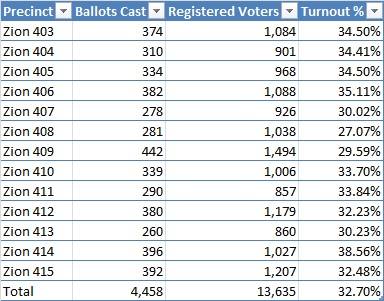
Turnout Percentages for Zion on March 15, 2016
However, there is cause for concern, because Zion has a history of voter apathy. Looking at the percentages shown in the table above compared to the official turnout for Lake County of 44.20%  I think that concern is justified.  My hope, as the election season shifts from the primaries and conventions to the finish in November is that people will shake off their apathy and become engaged in the process. Because the fall election isn't just about the Presidency, it's about all the down ballot races for Senate, Congress, State Senate, State Representative, States Attorney, and several County wide offices, all of which are very important, no doubt.

The challenge for everyone like myself who believe in the importance of participating in our system of self-governance, is getting people who come out of hibernation every four years for the Presidential election to come out again to vote in the April election that follows.  As I have been saying for the past four years; local, municipal, and school board elections, the ones that get almost no attention at all, are the elections that have the biggest impact on our daily lives.  

The truth is that most of the taxes you actually pay will go to the governing bodies controlled by the people who will be elected in the Consolidated General Election in April 2017.

If you are upset that your property taxes keep going up while the value of your home drops, or that your street is turning into a field of potholes, or the schools are taking more money and the results aren't getting better, then you have to do more than vote on November 8th, you must mark your calendar for April 4, 2017 and get out the door to the polls!

I hope that you will join me.

Monday, February 29, 2016

Vote for One

Unopposed

It's Leap Day today, and the first day of early voting for the March 15th primary election here in Illinois.  Since today is an "extra day" I decided to take a vacation day from work and take care of a couple of errands, including going to vote.

And, I just won my first election.

I have been on the ballot twice before in non-partisan municipal elections, and the signers of my nomination petitions for those races were a pretty healthy mix of Democrats, Republicans, and Independents.  As I have said many times, decisions made by local government have more impact on our daily lives than anything happening in Springfield or Washington D.C., and maintaining that spirit of non-partisanship is key to making municipal government work for everyone.

However, municipalities, park districts, school districts, and water districts also have to operate in the context of the broader county, state, and federal government. This requires having an understanding of the political aspects of governance, and getting involved in the political process. As both a candidate, and as Water District Trustee I have had conversations with State and Federal elected officials on issues of local concern. I've also used those conversations as opportunities to push for a policy or initiative that would benefit the residents of Zion.

After the last election, I decided that I didn't want to sit on the sidelines for another two years waiting for another shot at Commissioner, so I volunteered to be the Democratic Committeeman for Zion Precinct 411.  I often get asked the following question:
WHAT IS A PRECINCT COMMITTEEPERSON?
Your job as a precinct committeeperson is simple: Find Democratic and Democratic-leaning voters, get them registered to vote and get them to the polls. The office of the precinct committeeperson is the most important position in the entire Democratic Party.

You can also be the most effective person in your area to get out the vote for Democratic candidates. People trust a neighbor, even if they’ve never met you, to give them objective information about candidates. You can pick and chose the candidates you support...or you can support the entire Democratic slate.

Every two years, in the primary election, you may run to be the elected committeeman for your precinct. An elected precinct committeeman is a Democratic Party official at the local level. Once you are elected, you have a voice in what your county Democratic Party does. You are also on the front lines in elections, invited to special events with top candidates and absolutely essential to winning elections!  - Lake County Democratic Party www.lakedems.org
 The late author Hunter S. Thompson said, "Politics is the art of controlling your environment."  It logically follows that in order to exercise that control we have to get involved in politics. I actually get angry when I hear people refuse to get involved, or even to vote because 'all politicians are corrupt', and 'it doesn't make any difference'.  It's the laziest attitude that I can imagine, and one that too often becomes a self-fulfilling prophecy.  You want better people in office? Get up off the couch and volunteer on a campaign.  You want policies that reflect and respect your beliefs and values? Then get involved in a political party that meshes with your ideals, and make it better by adding your voice.

I decided to add my voice, so I am on a partisan ballot for the very first time.

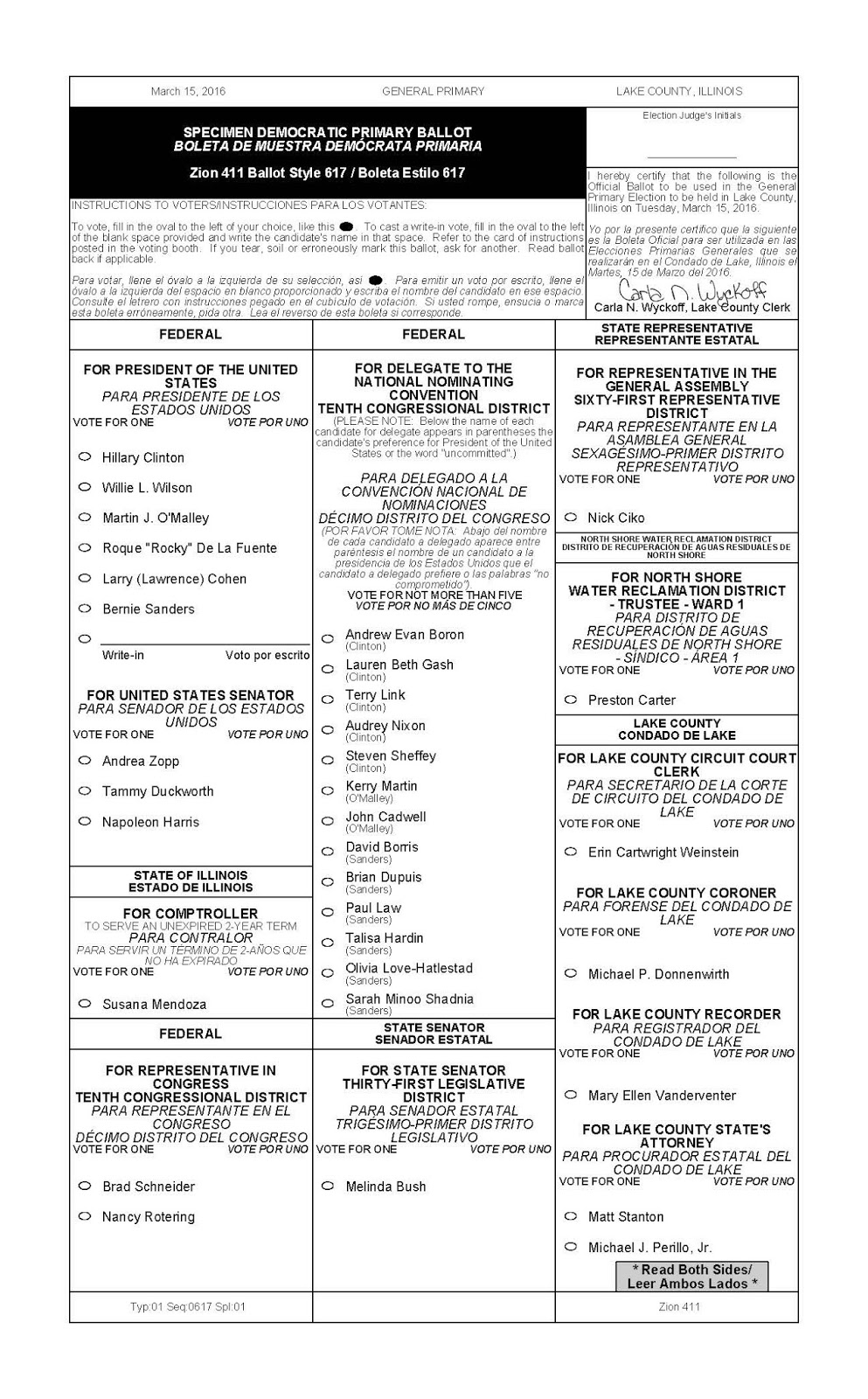
I'm way down at the bottom, and as you can see, I have no opponent so I win by default.  Which is common in primary elections, especially for minor positions, or even for some higher offices.  It becomes more troubling when there are candidates in the general election without an opponent, and that is something that really needs to change.

In the meantime, as I said at the start, this is the first day of early voting and there are some offices where there is a contested primary, and if there isn't a primary challenge, there is an opportunity to learn about new candidates that will be on the ballot in November.

Meet the Candidates

If you are a Lake County voter, and would like to learn more about the candidates in the Primary Election, there will be a chance to learn more from them, or their surrogates at the following event.

Meet the Candidates on Thursday, March 10 at the Zion Benton Public Library, 2400 Gabriel Ave, Zion IL.  The event starts at 6:30 p.m. in Room A. 

Candidates participating or represented:

Brad Schneider - U.S. Representative District 10 schneiderforcongress.com

Nancy Rotering - U.S. Representative District 10 nancyroteringforcongress.com

Melinda Bush - State Senate District 31 melindaforsenate.com 

Nick Ciko - State Representative District 61

Mary Ellen Vanderventer - Lake County Recorder of Deeds

Mike Perillo - Lake County States Attorney  perillo2016.com   

John Idleburg - Lake County Board District 4  elect_john_idleburg_4@yahoo.com 

Preston Carter - North Shore Water Reclamation District 1  votesmartervotecarter@gmail.com 

Tammy Duckworth - U.S. Senate tammyduckworth.com 

Andrea Zopp - U.S. Senate andreazoppforsenate.com

Of course the Presidential candidates have their websites:

Hillary Clinton  hillaryclinton.com

Bernie Sanders berniesanders.com  

An informed voter is the foundation of our democracy. I encourage everyone to get informed, and vote for the candidates of your choice on March 15th.

Sunday, October 25, 2015

Home Rule - "I don't think that means what you think it means."

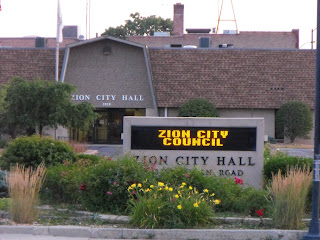
Zion City Hall
Zion IL, City Hall. Author's Photo

The Magic Number - 25,000

After attending a number of City Council meetings, doing my research on how local government functions, and speaking with a number of people, I began to notice a couple of recurring themes.

First, an almost reflexive negative response on the part of Council members to any kind of regulatory change or ordinance amendment that might result in a very minor cost to homeowners or businesses.  Being good stewards of the public's funds is admirable, but in comparison to the millions of dollars that were doled out to patch the city budget, or to pay for the Fielder's fiasco, the adage "penny wise and pound foolish"  is totally appropriate when looking at the performance of past city councils (see my previous blog post "One Time Dollars" ).  In my opinion, this almost overt aversion to raising fees or taxes, for any reason, has placed the City government into a trap of it's own creation. Even after a number of measures taken to cut costs and services, operational costs have continued to rise, and by not raising the tax levy for a number of years, and expending all of the cash reserves to cover the gaps, the city is now behind the curve and facing a deficit of $1.6 million dollars in the next fiscal year. In their unwillingness to face the ire of taxpayers over what would be a minor increase a few years ago, they kicked the can down the road until it grew into the problem we face today. Balanced budgets require a realistic view of revenues and expenses, ignoring one in favor of the other will result in disaster.  The current impasse in Springfield is exhibit A of this truth, and Zion has placed itself in a similar bind.

Second, is what I refer to as the "our hands are tied" response when confronted by citizens upset over these changes, when there is a cost involved, or just as often when no action is taken over an issue of concern.  Nuisance ordinances, and rental property licensing were two topics that often received the "we really can't do anything, our hands are tied" response for years. Immediately followed by "If we had Home Rule, then maybe we could do something about it, but we haven't hit that 25,000 population mark, so we really can't do much." An answer which ignored the fact that home rule can be obtained by referendum, and that there are alternative avenues available to governments to deal with those issues without home rule powers.

Invoking the magic effect of Home Rule is a bit of a dodge, it's another way of deflecting criticism and justifying continued inaction on the part of government. In and of itself, Home Rule does offer another set of tools for municipalities and counties, but it is not a free pass for those governing bodies to do whatever they want in every case.

Under the Illinois Constitution, Article VII, Section 6 (a) " A County which has a chief executive officer elected by the electors of the county and any municipality which has a population of more than 25,000 are home rule units. Other municipalities may elect by referendum to become home rule units. Except as limited by this Section, a home rule unit may exercise any power and perform any function pertaining to its government and affairs including, but not limited to, the power to regulate for the protection of the public health, safety, morals and welfare; to license; to tax; and to incur debt."

Now, the interpretation of home rule powers is fairly liberal, except in any area where the State has already determined a legislative interest, or where there is a broader interest involved.  That is why in cases of Home Rule, the actions almost always are related to local taxes. Primarily alternate revenue taxes; Municipal Retailers and Service Occupation Taxes, Hotel/Motel Tax (home rule lifts the tourism promotion restriction and allows other uses for the funds), Gasoline Tax, Use Tax, Cigarette Taxes, and the ability to raise Property Taxes beyond the State imposed 5% cap, or to impose limits on the governing body to raise those taxes.

Another area where home rule is often used is in rental property regulation, and this takes us back to the "our hands are tied" theme that was often invoked.  When I was researching for my first campaign, one of the things I learned was that a Rental Property inspection and certification program was a recommendation in the city development plan that was passed in 1992. By state law an inspection program was restricted for non-home rule communities, in that the fees could not exceed the administrative costs, otherwise it would be considered a revenue generating tax, which is not allowed for under non-home rule.  In bringing up this proposal during the campaign, I would often get the "don't we need home rule to do that?" in response.

In the intervening decades the unwillingness of City government to deal with the issue of residential rental properties, unless we happened to hit that magic number of 25,000, set the stage for our current housing crises. Today, in the wake of the 2008 economic disaster, and the collapse of the housing market, Zion now has a rental to ownership ratio of 60% to 40%, which is not a healthy situation for any community.  Circumstances have finally brought the City Council around to acting on the problem by implementing a certification program starting this year.  Unfortunately, the legacy of decades of avoidance have come back to haunt them, because now the costs of implementing and administering the program is much greater than it would have been if it had been adopted when first recommended.  So, instead of an inspection program that is just part of the duties of the regular Building and Zoning department, with a moderate fee, what is being proposed is a high fee per unit ($100) that is necessary to pay for the additional staff to carry out the program now.

This is the price of avoidance, in the short term I don't doubt that doing so helped some people get re-elected a number of times, but the long term damage to the City may not be known for years.

Water Sense - a broader interest

 The incident that prompted my writing this article occurred at a recent City Council meeting during a discussion of amendments to the municipal code regarding water use conservation.  These amendments were required under the directive of the Illinois Department of Natural Resources, the agency that holds the responsibility of administrating the allocation of Lake Michigan Water to Illinois communities.  The legal basis of which is:

The a U.S. Supreme Court Decree [Wisconsin v. Illinois, 49 U.S. 48 (1980) that limits Illinois' diversion of Lake Michigan water also contains language directing Illinois to implement a water conservation program. The Level of Lake Michigan Act [615 ILCS 50] incorporates the Decree language which states that:
"all feasible means reasonably available to the State and municipalities, political subdivisions, agencies and instrumentalities shall be employed to conserve and manage the water resources of the region and the use of water therin in accordance with the best modern scientific knowledge and engineering practice." [615 ILCS 50/5]  
This is the operative judicial and statutory language that directs the Illinois Department of Natural Resources (Department) to develop and implement a water management and conservation program covering all  permittees of Lake Michigan water.

- Water Conservation and Efficiency Program Review Illinois' Fifth Report to the Compact Council and Regional Body, December 8, 2014
Water conservation of the Lake Michigan watershed isn't a small matter, water service over the long term to a growing population is a matter of the broadest interest.

In its mandate to carry out conservation measures as noted above the IDNR had set out new requirements regarding unaccounted water losses, lawn watering, and the use of Water Sense approved fixtures in new and replacement plumbing.

Water Sense fixtures are certified to save consumers up to 20% of their water costs over the lifetime of the equipment. It's similar to an EnergyStar rating on electronics. In the long term their use will be a benefit to the consumer, and to the environment.  Saving money and water are generally good things, I think most people would agree with that.

At that meeting, when the requirement for Water Sense fixtures was brought up, the specter of avoidance and the invocation of Home Rule raised their heads in a single exchange.

Commissioner McDowell (Public Safety) queried Director Ianson, of the Building and Zoning Department on how much the use of Water Sense fixtures will add to the cost of new construction, or repairs. (avoiding possible short-term pain in lieu of long-term benefits)

Director Ianson, replied that he did not know.

Commissioner McDowell then asked if Zion had Home Rule, would they be able to get out of following these directives?

I knew the answer before it left Ianson's lips. No. In this case Home Rule cannot trump State regulations, and I have to say, I was somewhat surprised that the Commissioner would even suggest using Home Rule in such a manner.

Home Rule has it's uses, if it implemented properly by a government that understands it's limitations.  Whether home rule is achieved by population or by referendum, lets hope that the City of Zion will exercise the wisdom and judgement necessary to use it successfully.

I highly recommend the work of James A. Banovetz on Home Rule issues in Illinois. In particular: Illinois Home Rule: A Case Study in Fiscal Responsibility, JRAP 32:31 (2002).